Volcanoes National Park Rwanda: Everything You Need to Know Before You Trek
Volcanoes National Park Rwanda: Everything You Need to Know Before You Trek
The driver turned off the main road just before dawn, and suddenly Kigali’s city lights were gone, replaced by dark hills, mist, and the faint outline of volcanic peaks rising against a charcoal sky.
I pressed my face against the cold window and felt something shift. A kind of quiet anticipation that you only get when you know you’re heading somewhere truly wild.
By the time we reached the park gates at Kinigi, the sun was beginning to push through the clouds. The volcanoes, Karisimbi, Bisoke, Muhabura, Gahinga, Sabyinyo, emerged one by one from the mist, ancient and impossibly still. And somewhere up there, in the dense tangle of bamboo and hagenia forest, the mountain gorillas were already moving through their morning.
If you are planning to visit Volcanoes National Park Rwanda, this guide covers everything you need to know before you go, from gorilla trekking permits and volcano hikes to the best lodges, what to pack, and the experiences that will stay with you long after you fly home.
Where Is Volcanoes National Park Rwanda?
Volcanoes National Park sits in the Musanze District of northwestern Rwanda, approximately 2 to 2.5 hours by road from Kigali. It forms part of the greater Virunga Massif, a chain of eight dormant volcanoes that straddle the borders of Rwanda, Uganda, and the Democratic Republic of Congo.
Established in 1925, Volcanoes National Park holds the distinction of being Africa’s first national park, a fact that feels both remarkable and entirely fitting when you stand inside it.
The park covers 160 square kilometres of montane forest, bamboo woodland, and open moorland, rising from around 2,400 metres at the base to 4,507 metres at the summit of Mount Karisimbi. It is one of the most biodiverse ecosystems in all of Africa, and one of the very few places on earth where you can stand within metres of a wild mountain gorilla.
Why Volcanoes National Park Rwanda Belongs on Every Africa Safari Itinerary
There are beautiful national parks all across East Africa. But Volcanoes National Park Rwanda occupies a category of its own.
This is the park that Dian Fossey chose when she came to study mountain gorillas in 1967. Her research camp, Karisoke, perched between the slopes of Karisimbi and Bisoke, became the foundation of everything we now know about gorilla behaviour and society. Her work, and ultimately her death, transformed global attitudes toward gorilla conservation. Without her, the mountain gorilla might not exist today.
That history is present everywhere in this park. It is in the forest. It is in the eyes of the rangers who patrol these slopes every single day. And it is in the fact that the mountain gorilla population, once down to just 254 individuals in the 1980s, has now recovered to over 1,000.
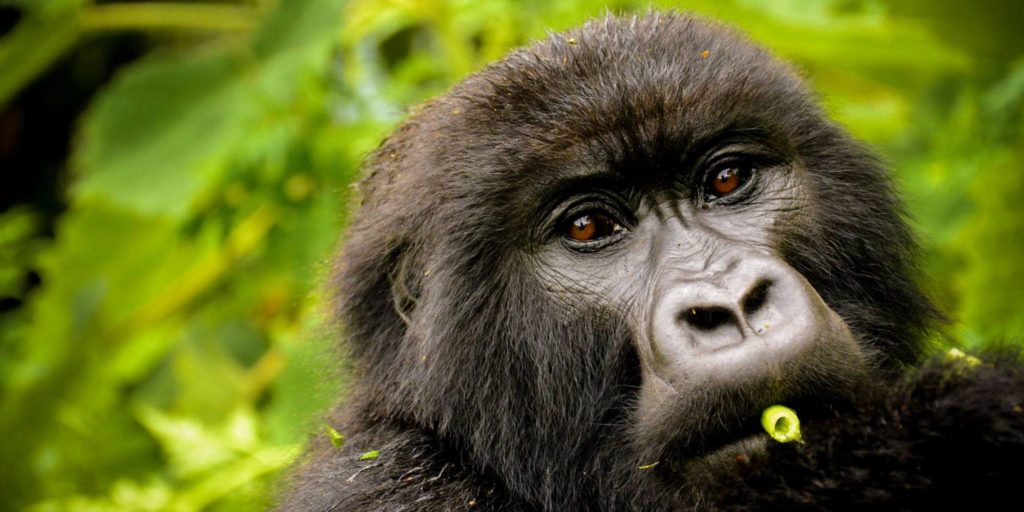
Volcanoes National Park is home to roughly half the world’s remaining mountain gorillas, spread across 12 habituated gorilla families, 8 of which are open to tourism. It also shelters golden monkeys, forest elephants, buffaloes, and over 200 bird species including the elusive Rwenzori turaco.
Beyond the wildlife, the park offers volcano hikes, cultural village visits, and the kind of landscape that makes you understand why this corner of Africa was once called the Switzerland of Africa.
Gorilla Trekking in Volcanoes National Park Rwanda
Let me be honest with you: nothing I write here will fully prepare you for the moment you find them.
You’ll have hiked for an hour, maybe two, through bamboo so dense it blocks the sky, up slopes so steep your guide has to pull you by the hand. You’ll be breathing hard, sweating through your layers, wondering quietly if this was a sensible idea.
And then your guide will raise a hand. Stop. Point.
A juvenile gorilla tumbles through the undergrowth three metres to your left. A mother sits with her infant pressed against her chest, watching you with an expression of absolute calm. The silverback, enormous, ancient, utterly unhurried, shifts his weight and exhales a long breath that you feel in your chest.
You will have exactly one hour. The time moves strangely, both impossibly fast and suspended in a way that ordinary hours never are.
Gorilla Trekking Permits: Cost and How to Book
Rwanda gorilla trekking permits cost USD $1,500 per person, issued exclusively by the Rwanda Development Board (RDB). Only 96 permits are available daily across 8 gorilla families, 8 visitors per family per day.
Permits can be booked:
- Directly through the RDB portal at rdb.rw
- Through a licensed tour operator like Africa Safari Tours, recommended for first-time visitors as operators handle availability, logistics, and itinerary planning
How far in advance should you book?
- Peak season (June to September, December to February): 6 to 12 months ahead
- Green season (April to May, November): 2 to 3 months ahead may suffice
Book your permit first. Build everything else around it.
What the Permit Fee Covers
- Park entry to Volcanoes National Park
- Expert ranger guide for your gorilla family group
- Full safety support throughout the trek
- Your one hour with the gorillas
A meaningful portion of every permit fee funds anti-poaching patrols, ranger salaries, veterinary care for the gorillas, and direct community development projects surrounding the park. When you buy a permit, you are actively funding gorilla survival.
The Trek Itself
Treks begin with a 7:00 AM briefing at the park headquarters in Kinigi, where rangers assign you to a gorilla family based on fitness level and divide groups of maximum 8 people. Trackers have already been in the forest since dawn locating the family’s position.
Hike duration ranges from 30 minutes to 4 hours depending on where the gorillas have moved. The terrain is steep and can be wet and muddy regardless of season, sturdy waterproof boots are non-negotiable.
Porter hire is available at the trailhead for approximately $15 to 20. It is strongly recommended, not just for practical reasons, but because porters are local community members whose income directly supports families living alongside the park.
Golden Monkey Tracking: Volcanoes National Park’s Most Playful Secret
If gorilla trekking is the headline act, golden monkey tracking is the underrated opening performance that many visitors leave raving about just as much.
The golden monkey, Cercopithecus kandti, is endemic to the Virunga Massif and found nowhere else on earth. Troops of 60 to 80 individuals move through the bamboo forest in a blur of auburn, gold, and black, leaping between stems, tumbling over each other, and regarding humans with a bold, inquisitive confidence that gorillas, by contrast, entirely lack.
A golden monkey tracking permit costs USD $100 per person, a fraction of the gorilla permit, and the experience is genuinely extraordinary. For travellers on a tighter budget or those with an extra morning to fill, this is one of the best value wildlife experiences in East Africa.
Hiking the Volcanoes of Rwanda
Mount Bisoke,The Most Popular Day Hike
At 3,711 metres, Mount Bisoke is Volcanoes National Park’s most accessible volcano summit and offers one of Rwanda’s finest day hikes. The trail winds through dense forest before opening onto open moorland, and the summit rewards with a perfectly circular crater lake, one of the most beautiful natural features in the Virungas.
The hike takes approximately 5 to 6 hours return and is rated moderately challenging. A ranger guide is required.
The Dian Fossey Tomb Hike
For many visitors, this is the most emotionally resonant experience in Volcanoes National Park Rwanda. A 3 to 4 hour hike to the ruins of Dian Fossey’s Karisoke Research Centre and her grave. This is where she was buried alongside the gorillas she dedicated her life to protecting.
Standing at her grave, a simple stone marker surrounded by the forest she loved, is a profoundly moving experience. It is worth every step of the climb.
Mount Karisimbi: Rwanda’s Highest Peak
For serious hikers, Karisimbi at 4,507 metres is the ultimate challenge. This is a 2-day overnight hike with camping on the mountain, cold, demanding, and staggeringly beautiful. Summit views on a clear morning stretch across Rwanda, Uganda, and the DRC.
Best Time to Visit Volcanoes National Park Rwanda
Gorillas can be tracked year-round, the season affects conditions, not access.
Dry Season: June–September and December–February
- Best trail conditions for trekking and volcano hikes
- Clearer summit views and better photography light
- Highest permit demand, book 6 to 12 months ahead
- Most popular season for East Africa safari travel
Green Season: April–May and November
- Forest is extraordinarily lush and atmospheric
- Fewer visitors on the trail, a quieter, more intimate experience
- Muddier trails and heavier rainfall, especially in the afternoons
- Better permit availability and occasionally lower lodge rates
- Exceptional birding as migratory species are present
For travellers combining Volcanoes National Park with a broader East Africa safari. Including a Uganda wildlife safari, chimpanzee tracking in Kibale, game drives in Queen Elizabeth National Park, or the dramatic Murchison Falls National Park, the dry season months of June to September offer the best conditions across all destinations simultaneously.
How to Get to Volcanoes National Park Rwanda
By Air
Fly into Kigali International Airport (KGL), which receives direct flights from major African hubs including Nairobi, Addis Ababa, Johannesburg, and Entebbe. Several European carriers also fly direct to Kigali.
By Road from Kigali
The drive from Kigali to Musanze (the gateway town to Volcanoes National Park) takes approximately 2 to 2.5 hours on well-maintained tarmac roads through Rwanda’s famous terraced hills. Private transfers arranged through your tour operator are the most comfortable and reliable option.
From Uganda
For travellers combining a Uganda safari with Rwanda gorilla trekking, the border crossing at Katuna/Gatuna connects the two countries. The drive from Kampala to Musanze takes approximately 8 to 9 hours, long but scenic, passing through southwestern Uganda’s rolling highlands. Many travellers visiting Bwindi Impenetrable National Park in Uganda cross into Rwanda from Kisoro for a seamless primate safari combining both countries.
Where to Stay Near Volcanoes National Park Rwanda
Luxury
Bisate Lodge, Arguably Rwanda’s most celebrated eco-lodge, perched on the eroded cone of an extinct volcano with jaw-dropping Virunga views. Six forest villas, immersive conservation ethos, and extraordinary service. A benchmark property.
One&Only Gorilla’s Nest, Secluded, elegant, and seamlessly designed around the forest landscape. Exceptional guides and the finest food in the region.
Singita Kwitonda Lodge, The newest and most architecturally striking luxury option, positioned at the park boundary with direct access to the forest.
Mid-Range
Mountain Gorilla View Lodge, Long-established, well-run, and positioned with superb volcano views. A favourite for repeat visitors and safari groups.
Five Volcanoes Boutique Hotel, Charming, intimate, and excellent value at mid-range price point. Warm service and beautiful gardens.
Budget
La Locanda del Gorilla, Comfortable, clean, and friendly. A solid budget option within easy distance of the park.
Muhabura Hotel, Basic accommodation in Musanze town, popular with independent travellers and backpackers.
Booking tip: Reserve accommodation and gorilla permits simultaneously. The best lodges and peak-season permits fill up together, securing one without the other can leave gaps in your itinerary.
Cultural Experiences Around Volcanoes National Park
The wildlife is extraordinary. But Rwanda’s culture adds a depth to any Volcanoes National Park visit that pure safari travel cannot replicate.
Iby’iwacu Cultural Village, located at the park boundary, offers one of East Africa’s most genuine cultural tourism experiences. Traditional Rwandan dance, storytelling, archery, basket weaving, and a guided tour of a traditional homestead led by former poachers who are now conservation ambassadors. It is moving, joyful, and entirely authentic.
Community walks through Musanze connect visitors with local farmers, schools, and artisan cooperatives. The town itself, Rwanda’s second largest, has a warmth and energy that makes it well worth an evening of exploration beyond the park gates.
And the Dian Fossey Gorilla Fund’s Karisoke Research Centre, now based in Musanze, offers educational visits for travellers who want to go deeper into the science and story behind gorilla conservation. For anyone who has seen the film Gorillas in the Mist, standing in the place where Fossey worked is a powerful experience.
Plan Your Volcanoes National Park Rwanda Trek with Africa Safari Tours
Standing at the edge of that clearing, watching the silverback move through the morning light with a slowness that seemed almost deliberate, I understood something I hadn’t been able to articulate before.
These animals are not performing. They are not aware of being observed. They are simply living, in a forest that has been their home for longer than we can imagine, and we are the visitors.
That is the gift of Volcanoes National Park Rwanda. Not a tick on a bucket list, but a genuine encounter with wildness that reminds you of your own small place in the world.
At Africa Safari Tours, we specialise in bespoke Rwanda and East Africa safari itineraries that combine gorilla trekking in Volcanoes National Park with Uganda wildlife safaris, chimpanzee tracking, big game viewing, and cultural experiences for the journey of a lifetime.
Contact our team today to check gorilla permit availability, discuss your itinerary, and start planning your Volcanoes National Park Rwanda adventure. The forest is waiting.
FAQs – Volcanoes National Park Rwanda
Q1: How much does it cost to trek gorillas in Volcanoes National Park Rwanda?
A gorilla trekking permit in Volcanoes National Park Rwanda costs USD $1,500 per person. The permit is issued by the Rwanda Development Board and covers park entry, a professional ranger guide, and one hour with a habituated mountain gorilla family. It must be booked in advance, peak season availability can sell out 6 to 12 months ahead.
Q2: How do I get to Volcanoes National Park from Kigali?
Volcanoes National Park is approximately 2 to 2.5 hours by road from Kigali International Airport. Most visitors arrange a private transfer through their tour operator or lodge. The route passes through Rwanda’s stunning terraced hill country and the gateway town of Musanze, which has good accommodation and dining options.
Q3: What is the best time to visit Volcanoes National Park Rwanda?
Gorilla trekking is available year-round. Though the dry seasons, June to September and December to February, offer the best trail conditions, clearer views, and more comfortable hiking. The green season (April–May and November) brings lush forest scenery, fewer crowds, and occasionally better permit availability, though trails are muddier.
Q4: How difficult is gorilla trekking in Volcanoes National Park?
Gorilla trekking in Volcanoes National Park ranges from moderate to strenuous depending on where the gorilla family has moved on trek day. Hikes can last from 30 minutes to 4 hours. The terrain is steep and can be slippery. Hiring a porter is strongly recommended and hiring one supports local community livelihoods directly.
Q5: Can I combine Volcanoes National Park Rwanda with a Uganda safari? Absolutely, and it makes for one of the finest itineraries in East Africa. Many travellers combine gorilla trekking in Volcanoes National Park with Bwindi Impenetrable National Park in Uganda, adding chimpanzee tracking in Kibale, big game safaris in Queen Elizabeth National Park, and Nile adventures at Murchison Falls for a comprehensive multi-country safari experience.