Uganda Driving Tips: Essential Road Guide for Tourists
Uganda driving tips are essential reading before you get behind the wheel in the Pearl of Africa. Uganda offers breathtaking scenery, diverse wildlife, and a network of roads connecting some of East Africa’s greatest safari destinations. However, driving in Uganda presents challenges that differ significantly from roads in Europe, North America, or other parts of Africa. Road quality varies enormously. Traffic behavior in Kampala is chaotic at peak hours. Furthermore, national park tracks can become impassable without a proper 4×4 vehicle. This guide covers every Uganda driving tip you need for a safe, confident road journey. For those preferring guided transport, explore our Uganda safari packages as a stress-free alternative.
Why Uganda Driving Tips Matter for Tourists
Uganda’s road network has improved considerably over the past decade. Nevertheless, driving conditions remain significantly different from what most international tourists are accustomed to. Consequently, understanding road rules, hazards, and local driving culture before departure prevents dangerous situations and frustrating delays.
Furthermore, self-drive safari options in Uganda are growing in popularity among independent travelers. A well-planned self-drive trip offers flexibility and deeper immersion in the landscape. However, it also demands preparation that guided tours handle automatically. Therefore, these Uganda driving tips apply equally to self-drive tourists and those simply traveling between destinations in hired vehicles. Our Uganda self-drive safari guide covers vehicle hire and route planning in additional detail.
Uganda Road Rules Every Driver Must Know
Drive on the Left
Uganda follows the left-hand side of the road driving rule, inherited from British colonial administration. Therefore, drivers from continental Europe, the United States, and most of Asia must consciously adjust before setting off. The adjustment takes most drivers one to two hours to feel natural. Additionally, right-hand drive vehicles are standard across Uganda, matching the left-side driving convention.
Intersections and roundabouts follow standard left-hand traffic flow. However, enforcement of lane discipline and right-of-way is inconsistent in practice. Consequently, defensive driving and constant observation of other vehicles matters more than assuming other drivers will follow rules predictably.
Speed Limits
Uganda’s national speed limits are 80 kilometres per hour on open highways and 50 kilometres per hour in urban and built-up areas. Furthermore, school zones and market areas carry lower implied speed limits enforced by police presence. Speed bumps, locally called sleeping policemen, appear without warning on many roads, including highways. Therefore, constant vigilance for unmarked bumps prevents vehicle damage and passenger discomfort.
Speed cameras operate on some sections of the Kampala-Jinja and Kampala-Masaka highways. Additionally, police roadblocks are common throughout Uganda. Officers routinely check driving licenses, vehicle registration documents, and third-party insurance. Therefore, carry all documents in the vehicle at all times without exception.
Required Documents
Always carry the following documents when driving in Uganda. Your international driving permit is required alongside your home country driving license. Furthermore, vehicle registration papers and valid third-party insurance must be available for inspection at roadblocks. Additionally, tourists hiring vehicles should carry a copy of the hire agreement. Failure to present documents at police checkpoints results in delays and potential fines.
Uganda Driving Tips: Understanding Road Conditions
Tarmac Roads
Uganda’s main tarmac roads connect Kampala to major regional centers including Jinja, Masaka, Mbarara, Fort Portal, and Gulu. These routes are generally well-maintained and driveable in standard saloon vehicles. However, potholes appear without warning, even on recently repaired sections. Consequently, driving at moderate speeds and scanning the road surface ahead prevents tire damage and suspension problems.
The Kampala-Entebbe Express Highway is Uganda’s best-maintained road. It offers a smooth, fast connection between the airport and the capital. Furthermore, the Kampala Northern Bypass reduces transit time through the city considerably during peak hours.
Dirt and Murram Roads
A significant portion of Uganda’s road network consists of unpaved murram (red gravel) roads. These routes connect smaller towns, villages, and national park entrances. Additionally, most tracks inside national parks are unpaved dirt roads that become extremely challenging after heavy rain.
Murram roads in dry conditions are dusty but generally manageable in a competent 4×4 vehicle. However, during the rainy seasons from March to May and October to November, the same roads can become deeply rutted, slippery, and occasionally impassable. Therefore, checking current road conditions before departure on any murram route is essential Uganda driving advice.
4×4 Requirement for Safari Driving
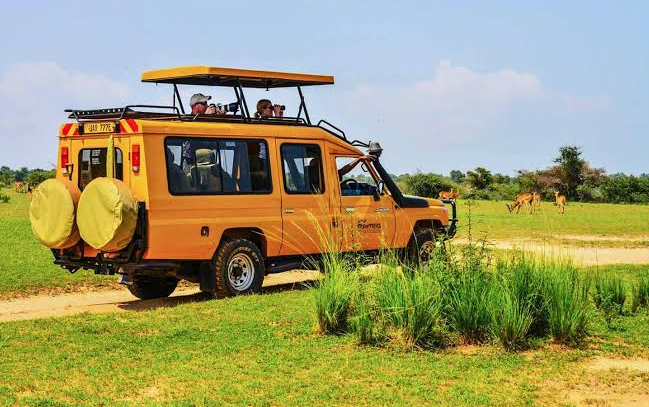
A 4×4 vehicle is non-negotiable for driving inside Uganda’s national parks. Furthermore, several approach roads to parks including Bwindi, Kidepo, and Mgahinga require 4×4 capability even in dry conditions. Standard saloon vehicles and two-wheel-drive SUVs are unsuitable for these routes.
High-clearance 4×4 vehicles with low-range gearboxes handle Uganda’s challenging terrain most effectively. Additionally, a roof rack for extra fuel canisters and luggage increases practicality on long routes between remote destinations. Consequently, tourists hiring self-drive vehicles in Uganda should insist on a genuine 4×4 with proven off-road capability rather than a standard SUV.
Uganda Driving Tips for Kampala Traffic
Kampala is one of East Africa’s most congested cities. Peak-hour traffic, from 7:00 to 9:00 AM and 5:00 to 8:00 PM, reduces movement across the city to a crawl. Furthermore, Kampala’s hilly terrain and densely packed road network create bottlenecks that experienced locals navigate through alternative routes unfamiliar to visitors.
Therefore, the most important Uganda driving tip for Kampala is to avoid peak hours whenever possible. Schedule departures for long road journeys before 7:00 AM. This single adjustment saves multiple hours on routes heading west, north, or east from the capital.
Boda Bodas and Minibus Taxis
Two transport types dominate Kampala’s roads and create unique hazards for visiting drivers. Boda bodas (motorcycle taxis) weave unpredictably between lanes at speed and appear suddenly in blind spots. Consequently, checking mirrors and blind spots far more frequently than usual is a critical Uganda driving habit in urban areas.
Minibus taxis stop abruptly and without warning to pick up or drop off passengers. Furthermore, they frequently pull back into traffic without signaling. Therefore, maintaining generous following distances behind any minibus reduces collision risk significantly. Additionally, never drive alongside a minibus taxi when it is approaching a roadside stop.
Fuel and Breakdown Uganda Driving Tips
Finding Fuel Stations
Fuel is widely available in Kampala, Entebbe, Jinja, Mbarara, Fort Portal, and other major towns. However, fuel stations become increasingly sparse on routes approaching remote national parks. Consequently, filling your tank completely before leaving any major town is a non-negotiable Uganda driving rule.
Additionally, carrying a spare five to ten litres of fuel in an approved jerry can provides reassurance on long remote drives. The route from Kabale to Bwindi and the road from Kotido to Kidepo Valley are particularly remote. Therefore, fuel planning on these routes requires careful advance calculation of distance versus consumption.
Breakdown Preparation
Mechanical breakdown in a remote area presents a serious logistical challenge. Therefore, inspect your vehicle thoroughly before any long journey. Check tyre pressure and condition, oil levels, coolant, brake fluid, and battery terminals. Additionally, carry a comprehensive spare parts kit including two spare tyres, a jack, wheel brace, jump leads, basic tools, and tow rope.
A satellite communicator or local SIM card with credit ensures you can call for assistance even in areas without strong mobile network coverage. Furthermore, informing your accommodation or tour operator of your planned route and expected arrival time provides a safety net if you fail to arrive as scheduled.
Key Safari Routes and Uganda Driving Tips Per Route
Kampala to Murchison Falls (approximately 305km)
This route heads north from Kampala via the Kampala-Gulu Highway. The road is tarmac as far as Masindi and beyond toward the park gate. Furthermore, the stretch from Masindi to Murchison Falls passes through the Budongo Forest Reserve, offering excellent birding opportunities from the roadside. Allow five to six hours including stops. Consequently, departing Kampala before 7:00 AM ensures arrival before dark.
Kampala to Bwindi Impenetrable National Park (approximately 530km)
This is Uganda’s longest and most demanding safari drive. The route heads southwest via Masaka, Mbarara, and Kabale before reaching Buhoma or Nkuringo. Furthermore, the final section from Kabale to Bwindi involves steep, winding mountain roads with dramatic valley views. Allow eight to ten hours total. Therefore, an overnight stop in Mbarara or Kabale is strongly recommended rather than attempting the drive in a single day.
Kampala to Queen Elizabeth National Park (approximately 420km)
The Queen Elizabeth route follows the southwestern highway via Masaka and Mbarara. Road conditions are good as far as Mbarara. Additionally, the road from Mbarara to Kasese passes through the foothills of the Rwenzori Mountains, offering spectacular highland scenery. Allow six to seven hours. Furthermore, the Equator crossing at Kayabwe provides a worthwhile photo stop midway through the journey.
Kampala to Kibale Forest National Park (approximately 315km)
The Kibale route travels west via Fort Portal, passing through tea estates and crater lake country. Road conditions are generally good on this route. Consequently, it is one of Uganda’s more pleasant driving experiences on tarmac. Allow approximately five hours including stops. Additionally, the Fort Portal area offers excellent crater lake viewpoints worth a brief detour.
Night Driving in Uganda: A Critical Safety Warning
Night driving is strongly discouraged across all Uganda roads. Consequently, this is perhaps the most important Uganda driving tip of all. Roads are poorly lit outside major towns. Pedestrians, cyclists, and animals frequently use the road surface after dark without reflective clothing or lighting.
Furthermore, vehicle breakdowns left on the road without adequate warning triangles create sudden hazards invisible until dangerously close. Overloaded trucks traveling slowly without functional rear lights are common on major highways after dark. Therefore, plan all journeys to complete well before sunset without exception.
If an unexpected delay forces night driving, reduce speed dramatically, use full headlights at all times, and increase following distances substantially. Additionally, inform someone of your location and expected arrival time so assistance can be arranged if needed. For emergency road information, the Uganda Police Force traffic department publishes advisories on major road incidents and closures.
Essential Uganda Driving Tips Quick Reference
| Situation | Key Uganda Driving Tip |
|---|---|
| Side of road | Drive on the LEFT always |
| Speed limit | 80km/h highway, 50km/h urban |
| Vehicle type | 4×4 mandatory for safari parks |
| Kampala traffic | Depart before 7:00 AM or after 8:00 PM |
| Boda bodas | Check mirrors constantly in cities |
| Fuel | Fill up completely before remote routes |
| Night driving | Avoid entirely — plan arrivals before dark |
| Rain season | Check road conditions before departure |
| Documents | License, permit, insurance, registration |
| Breakdowns | Two spare tyres, tools, communication device |
Car Hire Tips for Self-Drive Uganda Visitors
Choosing the right vehicle hire company is as important as any other Uganda driving tip. Furthermore, the quality difference between reliable and unreliable operators is significant. Always inspect the vehicle physically before accepting it. Check tyre condition on all four wheels plus the spare. Additionally, test the 4×4 engagement, low-range gearbox, and all lights before signing the hire agreement.
Request a vehicle with comprehensive insurance that covers off-road damage. Many basic hire agreements exclude national park track damage, which is precisely where problems occur most frequently. Therefore, read the small print carefully and ask explicitly about coverage before paying. Our Uganda car hire recommendations page lists trusted operators with verified vehicle standards.
Final Thoughts on Uganda Driving Tips
Uganda driving tips ultimately come down to preparation, patience, and respect for the road environment. Uganda’s roads have improved significantly and continue to develop. However, they remain unpredictable enough to demand constant alertness. Departing early, fueling thoroughly, carrying documents, and avoiding night driving resolves the majority of driving challenges tourists encounter.
For travelers who prefer the comfort and convenience of guided transport, our experienced driver-guides handle all of the above seamlessly on your behalf. Contact us today to plan your Uganda safari with full transport arrangements included.