A Guide to Golden Monkey Permits in Rwanda: Cost, Booking & What to Expect
Sophie had already paid for her gorilla permit.
She was scrolling through her Rwanda itinerary when she noticed something. An activity listed for the afternoon of her trek day: golden monkey tracking. She had never heard of it. She called us immediately.
“What is a golden monkey?” she asked. “And do I need another permit?”
By the time we had finished explaining, she had added the golden monkey tracking to her booking without hesitation.
Golden monkey permits in Rwanda are one of the country’s most overlooked wildlife opportunities. Most visitors arrive focused entirely on the gorillas, understandably. However, the golden monkey tracking experience in Volcanoes National Park is genuinely extraordinary. Furthermore, at a fraction of the gorilla permit cost, it represents some of the finest wildlife value in East Africa.
This guide covers everything you need to know about golden monkey permits in Rwanda, the cost, how to book, what the experience is like, and exactly how to integrate it into your Rwanda safari itinerary.
What Is the Golden Monkey?
The golden monkey (Cercopithecus kandti) is an endangered primate found only in the Albertine Rift highlands. Specifically, its range covers the Virunga Massif, the volcanic mountain range shared by Rwanda, Uganda, and the DRC, and Rwanda’s Gishwati Forest.
It is one of the most visually striking primates in Africa. The combination of brilliant orange-gold flanks and jet-black cap, face, and limbs creates an appearance that is entirely unlike any other monkey in East Africa. Furthermore, the animals are highly active and vocal. Consequently, tracking them through bamboo forest produces a fast-paced, joyful experience that contrasts completely with the meditative quality of gorilla trekking.
According to the IUCN golden monkey status assessment, the species is classified as Endangered. Habitat loss and forest fragmentation are the primary threats. Therefore, the tourism programme managed by the Rwanda Development Board directly funds the conservation infrastructure protecting the golden monkey’s Virunga habitat.
The habituated golden monkey communities in Rwanda’s Volcanoes National Park contain several dozen individuals. They are fully accustomed to human observers. Consequently, encounters at very close range, 2 to 5 metres, are routine and reliably produced on most tracking days.
Golden Monkey Permits in Rwanda: Cost and Inclusions
The golden monkey permit in Rwanda costs $100 USD per person per tracking session.
This is a fixed fee set by the Rwanda Development Board. It does not vary by season, nationality, or booking channel.
What the $100 Permit Includes
- One tracking session with a habituated golden monkey community
- One hour of observation time with the community
- Professional ranger guide throughout the experience
- Park entry for the golden monkey tracking activity
- Post-tracking trekking certificate
What the Permit Does Not Include
- Accommodation at lodges near Volcanoes National Park
- Transportation to and from the park headquarters
- Porter hire ($10–$15, available at the trailhead, strongly recommended)
- Gorilla trekking permit ($1,500, this is a completely separate permit)
- Meals and personal expenses
The $100 golden monkey permit is dramatically more affordable than the $1,500 gorilla trekking permit. Furthermore, it provides access to a wildlife experience that many visitors describe as equally joyful, if different in character.
How to Book Golden Monkey Permits in Rwanda
Booking golden monkey permits in Rwanda is straightforward. However, advance booking is essential during peak season. There are two main booking channels.
Option 1: Book Directly Through the Rwanda Development Board
The Rwanda Development Board manages all Volcanoes National Park permits. You can book golden monkey permits directly at:
Website: www.rdb.rw In person: Rwanda Development Board offices in Kigali At the park: Limited same-day permits may be available at Volcanoes National Park headquarters in Kinigi. However, this is not reliable during peak season.
Direct booking requires:
- Passport details for each participant
- Payment in USD (credit card accepted online)
- Confirmation of your tracking date
Option 2: Book Through a Licensed Safari Operator
Most visitors book golden monkey permits through a safari operator as part of a complete Rwanda itinerary. This is the most practical approach. Furthermore, operators can coordinate permit dates with accommodation bookings, gorilla permit dates, and transfer logistics.
Our team at Africa Safari Tours handles golden monkey permit booking as part of complete Rwanda gorilla safari packages. Consequently, the coordination between permits, lodges, and transfers is managed as a single seamless package.
How Far in Advance to Book
June–September (long dry season): Book 2–3 months ahead. This is the busiest period. Consequently, same-day or short-notice permits are difficult to secure.
December–January (short dry season): Book 4–6 weeks ahead. Demand is lower than peak season.
March–May and October–November (wet seasons): Last-minute permits are often available. However, advance booking still provides certainty.
What Happens on a Golden Monkey Tracking Day
Understanding the tracking day structure helps you prepare effectively. Here is the complete day sequence.
Morning Briefing (7:00am)
All activities at Volcanoes National Park begin with a 7:00am briefing at the park headquarters in Kinigi. Golden monkey tracking groups gather alongside gorilla trekking groups at this briefing.
The ranger covers tracking rules:
- Maximum group size: 8 people per golden monkey community
- Minimum distance: 5 metres from the monkeys
- No flash photography
- No food or drink in the monkeys’ presence
- Follow ranger instructions at all times
Groups are then assigned and vehicles transfer participants to the bamboo forest entry point.
The Tracking Walk
The walk from the forest edge to the golden monkey community is typically short. Furthermore, the terrain is significantly less demanding than gorilla trekking. Consequently, golden monkey tracking is accessible to a wider range of fitness levels.
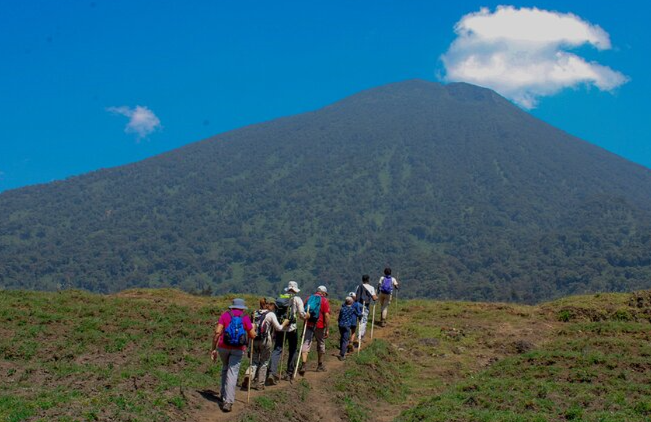
The bamboo forest zone at the base of the Virunga volcanoes is the golden monkey’s primary habitat. Rangers communicate with trackers who located the community at dawn. As a result, the walk to the community rarely exceeds 30–45 minutes.
The One-Hour Encounter
The golden monkey encounter is energetic from the first moment.
Unlike gorillas, which are typically calm and settled during observer visits, golden monkeys move constantly. They leap between bamboo stems with extraordinary speed. They call to each other in sharp, distinctive vocalisations. They come down to the forest floor, approach the observer group with open curiosity, and then leap back into the canopy.
Within the 5-metre minimum distance, encounters feel genuinely intimate. On many tracking days, individual monkeys approach significantly closer. The experience is simultaneously wild, these are completely free animals going about their lives, and remarkably accessible.
The ranger times the one-hour session precisely. Additionally, they provide commentary on the community’s social structure, individual animals, and the conservation context throughout the encounter.
Return and Certificate
After the encounter, the group returns to the forest edge. Your ranger writes a trekking certificate by hand, a physical record of the date and the community visited.
Additionally, tipping the ranger is customary and appropriate. A tip of $10–$15 per ranger is standard and deeply appreciated.
Golden Monkey Tracking vs Gorilla Trekking: Key Differences
Most Rwanda visitors consider combining both experiences. Consequently, understanding the differences helps with planning.
| Feature | Golden Monkey Tracking | Gorilla Trekking |
|---|---|---|
| Permit cost | $100 | $1,500 |
| Trek duration | 30–60 min to community | 45 min–5+ hours |
| Encounter time | 1 hour | 1 hour |
| Terrain difficulty | Easy to moderate | Moderate to hard |
| Experience character | Fast, energetic, joyful | Meditative, profound |
| Group size | Max 8 | Max 8 |
| Minimum age | No minimum | 15 years |
| Availability | Good year-round | Book 4–6 months ahead |
| Community size | Dozens of individuals | 10–40 per family |
The two experiences complement each other extraordinarily well. Furthermore, many visitors who do both on separate days describe the contrast as one of the most satisfying aspects of their Rwanda trip.
Can You Do Both Golden Monkey Tracking and Gorilla Trekking on the Same Day?
Yes, and many visitors do exactly this.
The scheduling works as follows: gorilla trekking is a morning activity. Most groups return from the gorilla encounter by 1:00pm–2:00pm. Golden monkey tracking can then be scheduled for the afternoon, departing at approximately 2:00pm–3:00pm.
However, there are important practical considerations.
Physical demand: Combining both in one day is demanding. Gorilla trekking can involve 4–5 hours of steep hiking. Consequently, adding a golden monkey tracking session requires reasonable fitness and energy reserves.
Scheduling confirmation: Both permits must be booked for the same date at the same park. Confirm this with your operator. Furthermore, weather and gorilla family location can affect the timing of your return from the gorilla trek.
The recommended approach: For most visitors, dedicating separate days to each experience delivers the most satisfying outcome. This allows full attention and energy for each encounter. Additionally, it gives you more time in the forest, which is always a good thing.
Best Time for Golden Monkey Permits in Rwanda
Golden monkey tracking operates year-round at Volcanoes National Park. However, specific seasons offer specific advantages.
June–September (long dry season): Optimal conditions. Bamboo forest trails are firm. The monkeys range predictably. Furthermore, the dry season light in the bamboo creates outstanding photographic conditions. This is the most popular window for golden monkey tracking, consequently, book ahead.
December–January (short dry season): Excellent tracking conditions with significantly lower visitor numbers. The bamboo has a freshness after the short rains that makes the forest particularly beautiful.
October–November and March–May (wet seasons): The bamboo forest is intensely green. Consequently, the visual atmosphere during tracking is extraordinary. The monkeys are active regardless of rain. However, trails can be muddy and waterproof clothing is essential.
According to Visit Rwanda, Volcanoes National Park’s activities are consistently available year-round. For detailed seasonal advice, see our best time to visit Rwanda for a safari guide.
How Golden Monkey Permits Support Conservation in Rwanda
Every $100 golden monkey permit contributes directly to the conservation of an endangered species and its habitat.
The Rwanda Development Board directs permit revenue to:
- Ranger and tracker salaries — the daily monitoring of golden monkey communities requires dedicated personnel funded by tourism revenue
- Habitat protection — the bamboo forest zone that constitutes the golden monkey’s primary habitat in Rwanda is protected within Volcanoes National Park, managed substantially with tourism revenue
- Revenue Sharing Programme — a percentage of all park revenue funds community development projects in the villages surrounding the park
Furthermore, the habituation programme that makes golden monkey tracking possible, a multi-year process of daily ranger contact with wild monkey communities, is itself a conservation intervention. Habituated communities that are regularly visited are intensively monitored. Consequently, health issues, injuries, and population changes are detected early.
The Dian Fossey Gorilla Fund has specifically noted the value of monitoring programmes that cover golden monkeys alongside gorillas in the Virunga ecosystem.
For a broader understanding of how your Rwanda safari spending supports conservation, read our Rwanda gorilla tour conservation article.
Practical Tips for Your Golden Monkey Tracking Day
What to wear: Long trousers and long-sleeved shirt (bamboo scratches). Waterproof hiking boots. Rain jacket in all seasons. Garden or grip gloves for steep or wet sections.
What to bring: Camera without flash. Minimum 1 litre of water. High-energy snacks. Insect repellent.
Photography: Golden monkeys in bamboo are one of the most challenging and most rewarding wildlife photography subjects in Africa. The animals move fast. Use burst mode. A camera with good autofocus tracking produces the best results. However, a good smartphone camera with a fast processor also works well.
Porter hire: Available at the park headquarters at $10–$15. The terrain is less demanding than gorilla trekking, but a porter is still useful for carrying your pack and supporting on muddy sections.
Minimum age: There is no minimum age for golden monkey tracking. Consequently, it is suitable for families with younger children who are below the 15-year gorilla trekking minimum age.
FAQs
Can I buy a golden monkey permit on arrival at the park?
Sometimes. Same-day permits are occasionally available at the Volcanoes National Park headquarters in Kinigi. However, availability is not guaranteed. Advance booking is strongly recommended.
Is the golden monkey tracking physically demanding?
It is significantly less demanding than gorilla trekking. The bamboo forest terrain is moderate and the walk to the community is typically short. Most people with basic fitness complete it comfortably.
How many golden monkeys will I see?
Habituated communities contain several dozen individuals. During a typical one-hour encounter, most visitors observe 20–40 animals in close proximity.
Can children do golden monkey tracking?
Yes. There is no minimum age restriction for golden monkey tracking. This makes it an excellent alternative for families whose younger children cannot do gorilla trekking.
How do I book golden monkey permits in Rwanda?
Contact Africa Safari Tours to book golden monkey permits alongside your complete Rwanda safari itinerary. We handle all permit coordination, accommodation, and transfers.
Conclusion: Golden Monkey Permits in Rwanda Are Worth Every Dollar
Sophie called after her trip. She had done the gorillas on Day 3. She had done the golden monkeys on Day 4 afternoon.
“They were completely different experiences,” she said. “The gorillas were profound. The golden monkeys were the most joyful wildlife experience of my life.”
Golden monkey permits in Rwanda are one of the country’s most accessible, most affordable, and most genuinely extraordinary wildlife opportunities. The $100 permit, compared to the $1,500 gorilla permit, feels almost too reasonable for what it delivers.
Don’t miss them. Book both permits. Dedicate a day or an afternoon to the bamboo forest and the most spectacular monkey in Africa.
Contact Africa Safari Tours to book your golden monkey permits in Rwanda alongside a complete Volcanoes National Park safari experience.